Full-Year Course · For Lucas 空 & Lucy 悟 · 36 Weeks · 6 Units
The Universe Reflected · 在天成象,在地成形
A year of reading the two books at once: what the sky writes above, the land writes again below.
在天成象,在地成形。
In the heavens, patterns are formed; on earth, shapes take form.
易經 · Book of Changes
The Core Principle
The universe is a unified whole, and the patterns of the sky are reflected in the patterns of the earth. What is written in the stars is also written in the land, in the waters, in the plants, and in the practices of the people.
For the Iñupiaq this is Sila — the living breath of the universe that connects all things. The movements of the stars (Qilak) are mirrored in the migrations of animals, the rhythms of the seasons, and the practices of the people. Sky and earth are not separate; they are in constant conversation.
For the Chinese this is 天人合一 (Tiānrén Héyī) — the unity of heaven and humanity. The patterns of the cosmos 天象 are reflected in the patterns of human life and land 地形. The 24 Solar Terms are this principle put to work: the movements of the sun and stars decide when to plant, when to harvest, when to celebrate.
三眼观世 · Three-Eyed Seeing for Cosmology
One sky, three ways of asking about it — none of them beneath another.
First Eye
Iñupiaq Epistemology
How does Sila connect the sky and the earth? How do the patterns of the stars guide the patterns of life on the land?
Second Eye
Chinese Philosophy
How does 天人合一 express the correspondence between heaven and earth? How do the 24 Solar Terms carry that principle into daily life?
Third Eye
Western Science
What is the physical basis for the correspondence between celestial and terrestrial patterns? How do we observe, measure, and test these connections?
Everything Written Twice · Chinese 天象 / 地形
The classical correspondence: a pattern in the heavens and its answering shape on the earth.
| Celestial Pattern 天象 | Terrestrial Form 地形 | Connection |
|---|---|---|
| 二十八宿 · The 28 lunar mansions | 十二地支 · The 12 earthly branches | Timekeeping, divination, the ordering of the year. |
| The movements of the sun 日行 | 二十四节气 · The 24 Solar Terms | The agricultural calendar and seasonal rhythm. |
| 五星 · The five planets | 五行 · The five elements | Cosmology, medicine, philosophy. |
| 星辰 · The stars | 山河 · Rivers and mountains | Feng shui, geography, sacred landscape. |
| 天河 · The Milky Way | 黄河 · The Yellow River | Mythology and sacred geography — one river written twice. |
Everything Written Twice · Iñupiaq Qilak / Nuna · Imak
Sila holds sky, land, and sea in one conversation — read for navigation, timing, and survival.
| Sky Pattern · Qilak | Earth & Sea · Nuna / Imak | Connection |
|---|---|---|
| Star positions | Animal migrations | Navigation and hunting. |
| Kiuguyat · the aurora | Spirits dancing | The spiritual world made visible. |
| Sun position | Seasonal change | Timing of harvest, hunting, and travel. |
| Weather patterns | Ice conditions | Safety and survival. |
| Constellations | Landmarks on the land | Wayfinding — the sky as a map of the ground. |
Everything Written Twice · Western Science
A different method arriving at the same claim: the sky and the ground are one system.
| Celestial Pattern | Terrestrial Pattern | Scientific Connection |
|---|---|---|
| The Sun's position | Seasons and climate | Earth's axial tilt and orbit. |
| The Moon's phases | Tides | Gravitational pull. |
| Solar radiation | Weather and climate | Solar energy drives Earth's systems. |
| Stellar composition | The elements in rock, water, and body | Nucleosynthesis in stars. |
Sila · Qilak · Nuna · Imak
| Word | Meaning | What it teaches |
|---|---|---|
| Sila | The living breath of the universe; weather; spirit; connection. | The universe is alive and we are part of it. |
| Qilak | The sky; the dome of the sky; the home of souls. | The sky is a source of life and of guidance. |
| Nuna | The land. | What the sky writes, the land answers. |
| Imak | The sea and its ice. | Sky, weather, and ice read as one system. |
The Full-Year Plan · 36 Weeks in 6 Units
Every week has a focus for Lucy and a focus for Lucas, and names which eye is leading.
Weeks 1–6
Unit 1 · What Is Cosmology? — Patterns Written Twice
The sky, the I Ching line that names the whole year, Sila and Qilak, and how each tradition observes.
| Week | For Lucy 悟 | For Lucas 空 | Three-Eyed Connection |
|---|---|---|---|
| 1 | What is the sky? — meeting the cosmos | What is cosmology? — the study of the universe | All three eyes |
| 2 | 在天成象,在地成形 — what does it mean? | 在天成象,在地成形 — the 易經·繫辭 source and its claim | Second Eye: Chinese cosmology |
| 3 | Sila and Qilak — the Iñupiaq cosmos | Sila and Qilak — the breath of the universe, the home of souls | First Eye: Iñupiaq cosmology |
| 4 | Observations of the sky — what do we see? | Observing the cosmos — methods across cultures | Third Eye: Scientific observation |
| 5 | The universe reflects — sky and earth connections | Celestial–terrestrial correspondence — reading the pairs | All three eyes |
| 6 | Reflection — what patterns did we find? | Reflection — journal entry on the two books | All three eyes |
Weeks 7–12
Unit 2 · The Sky as Calendar — Seasons and Time
The sun's path, the 24 Solar Terms, the Iñupiaq seasonal round, the moon and the tides.
| Week | For Lucy 悟 | For Lucas 空 | Three-Eyed Connection |
|---|---|---|---|
| 7 | The sun's path — tracking the sun | Earth's orbit and tilt — why seasons happen | Third Eye: Astronomy |
| 8 | The 24 Solar Terms — the Chinese seasonal calendar | 24 Solar Terms — origins, structure, significance | Second Eye: 節氣 |
| 9 | The Iñupiaq seasonal round — ice, fish, caribou, berries | The Iñupiaq calendar — subsistence cycles as timekeeping | First Eye: Subsistence |
| 10 | Moon phases — tracking the moon | Lunar cycles and tides — the gravitational connection | Third Eye: Astronomy |
| 11 | Comparing calendars — side by side | Comparative analysis — what each calendar is built to do | All three eyes |
| 12 | Reflection — how do we measure time? | Reflection — journal entry on time and rhythm | All three eyes |
Key insight — The 24 Solar Terms are the principle put to work: when the Dipper's handle points east, spring arrives on earth. This is cosmology in practice.
Weeks 13–18
Unit 3 · The Stars as Guides — Navigation and Direction
北斗七星, Ullaktut the Runners, celestial navigation, and the stories that carry the knowledge.
| Week | For Lucy 悟 | For Lucas 空 | Three-Eyed Connection |
|---|---|---|---|
| 13 | 北斗七星 — finding the Northern Dipper | 北斗七星 — seasonal rotation and its meaning | Second Eye: Chinese astronomy |
| 14 | Iñupiaq star knowledge — Orion's Belt, the Runners | Arctic navigation — the stars as guides | First Eye: Qilak |
| 15 | Using stars to find direction — simple navigation | Celestial navigation — methods across cultures | All three eyes |
| 16 | Constellations and stories — Chinese star legends | 牛郎织女 — the Cowherd and the Weaver Girl | Second Eye: Mythology |
| 17 | Iñupiaq star stories — oral traditions | Star legends — how stories encode knowledge | First Eye: Oral tradition |
| 18 | Reflection — how do the stars guide us? | Reflection — journal entry on wayfinding | All three eyes |
Key insight — 斗柄东指,天下皆春 — when the Dipper's handle points east, all under heaven is spring. Iñupiat read Orion's Belt as Ullaktut, the Runners, to predict the season. The same stars, two stories, one shared truth.
Weeks 19–24
Unit 4 · Celestial Events — Portents and Messages
The August 2026 alignment, 流星, Kiuguyat, and eclipses read by three traditions at once.
| Week | For Lucy 悟 | For Lucas 空 | Three-Eyed Connection |
|---|---|---|---|
| 19 | The August 12 events — six planets, eclipse, meteor shower | 2026 celestial events — scientific and cultural meanings | All three eyes |
| 20 | 流星 — shooting stars, heaven's messengers | 流星 — astronomy, divination, and meaning | Second Eye: 天人感应 |
| 21 | Kiuguyat — the aurora, spirits dancing | Aurora — Iñupiaq spiritual meanings and solar wind | First Eye: Sila |
| 22 | Solar and lunar eclipses — observing an eclipse | Eclipses in Chinese and Iñupiaq traditions | All three eyes |
| 23 | What do celestial events tell us? | Reading the sky — messages from the cosmos | All three eyes |
| 24 | Reflection — celestial events and meaning | Reflection — journal entry on portents | All three eyes |
Weeks 25–30
Unit 5 · Earth and Sky in Harmony — Cosmology in Daily Life
天人合一 and Sila as practice: planting, reciprocity, storytelling, and land-based learning.
| Week | For Lucy 悟 | For Lucas 空 | Three-Eyed Connection |
|---|---|---|---|
| 25 | 天人合一 in practice — harmony with nature | 天人合一 — philosophy carried into practice | Second Eye: 天人合一 |
| 26 | Sila in practice — living with the breath | Sila — reciprocity with the universe | First Eye: Sila |
| 27 | Gardening with the cosmos — planting by the sky | Astronomy and agriculture — ancient and modern | All three eyes |
| 28 | Restorative storytelling — stories of sky and earth | Restorative storytelling — positionality and narrative | All three eyes |
| 29 | Indigenous perspectives — connecting to the land | Indigenous cosmology and education — ecopedagogy | First Eye: Indigenous |
| 30 | Reflection — living in harmony with the cosmos | Reflection — journal entry on daily practice | All three eyes |
Weeks 31–36
Unit 6 · Integration — Three Eyes, One Cosmos
Comparing worldviews, the cosmos as teacher, and the year's culminating projects.
| Week | For Lucy 悟 | For Lucas 空 | Three-Eyed Connection |
|---|---|---|---|
| 31 | Comparing worldviews — Chinese, Iñupiaq, Western | Comparative analysis — similarities and differences | All three eyes |
| 32 | The cosmos as teacher — what we learn from the sky | Cosmology and education — Taoism and holistic learning | All three eyes |
| 33 | Project work — begin the Three-Eyed sky journal | Project work — research and outline | All three eyes |
| 34 | Project work — finalizing the journal and sky map | Project work — drafting and revision | All three eyes |
| 35 | Project work — preparing to present | Project work — finalizing and practicing | All three eyes |
| 36 | Celebration — share projects with family | Portfolio and presentation — present final projects | All three eyes |
Week 1 · Day by Day — Observing Celestial Patterns
The shape every week follows: observe together, split by depth, journal on Friday.
| Day | For Lucy 悟 | For Lucas 空 | Activity |
|---|---|---|---|
| Monday | What do you see in the sky? | How do the patterns of the sky connect to our lives? | Draw the sky; share what you noticed. |
| Tuesday | Sun and moon: where is the sun at breakfast, lunch, and dinner? | The sun's path, the solstices, and axial tilt. | Mark the sun's position three times in one day. |
| Wednesday | Find 北斗七星 (the Northern Dipper). | How stars guide travel — Polaris, circumpolar stars, and wayfinding. | Identify constellations; learn one story for each. |
| Thursday | What is Kiuguyat, the aurora? | Kiuguyat and Sila: the aurora as spirit and as solar wind. | Draw or photograph the aurora; write one reflection. |
| Friday | What did we see this week? | Journal: Sila and 天人合一 in one page. | Reflection in the sky journal. |
Week 2 · Day by Day — Observing Terrestrial Patterns
| Day | For Lucy 悟 | For Lucas 空 | Activity |
|---|---|---|---|
| Monday | What do you see on the earth? | How are the patterns of the earth connected to the sky? | An outdoor observation walk — no talking for the first ten minutes. |
| Tuesday | How have the plants changed? | Phenology: tracking seasonal cycles as data. | Observe and record plant change. |
| Wednesday | What are the animals doing? | Migration patterns and their timing against the solar terms. | Observe and record animal behavior. |
| Thursday | Where is the water, and what shape is it in? | The water cycle as the sky and the ground exchanging places. | Observe water as liquid, vapour, frost, and ice. |
| Friday | What did we see this week? | Journal: name three earth patterns that follow a sky pattern. | Reflection in the sky journal. |
Culminating Projects
What the year builds toward — one finished body of work for each of them.
For Lucy 悟
| Project | Description | Connection |
|---|---|---|
| Sky-Earth Journal | A year-long journal of observations: what appears in the sky, what appears on the earth. | 在天成象,在地成形 |
| Three-Eyed Sky Map | A map of the sky showing constellations from Chinese and Iñupiaq traditions. | All three eyes |
| Celestial Storybook | Stories of the sky and the earth, retold from both traditions in your own words. | First & Second Eyes |
For Lucas 空
| Project | Description | Connection |
|---|---|---|
| Comparative Cosmology Essay | Compare Chinese and Iñupiaq cosmological traditions — where they meet, where they differ. | All three eyes |
| Cosmology Research Paper | Research one aspect in depth: the 24 Solar Terms, Iñupiaq star knowledge, or 天人合一. | All three eyes |
| Restorative Storytelling Project | A story weaving Chinese, Iñupiaq, and Western cosmological perspectives together. | All three eyes |
Key Vocabulary 詞彙
The words this year turns on — practice them in the deck below.
| Tradition | Word | Meaning |
|---|---|---|
| Chinese | 在天成象,在地成形 | In the heavens, patterns are formed; on earth, shapes take form. |
| Chinese | 天人合一 | Harmony and unity between humans and the universe. |
| Chinese | 天人感应 | Heaven and humanity respond to each other. |
| Chinese | 節氣 · Jiéqì | The 24 Solar Terms. |
| Chinese | 北斗七星 | The Northern Dipper — the Big Dipper. |
| Chinese | 流星 | Shooting stars — heaven's messengers. |
| Iñupiaq | Sila | The living breath of the universe; weather; spirit. |
| Iñupiaq | Qilak | The sky; the home of souls. |
| Iñupiaq | Ullaktut | The Runners — Orion's Belt, read for seasonal timing. |
| Iñupiaq | Kiuguyat | The northern lights. |
| Iñupiaq | Iluaq | Wholeness, well-being, being in right relation. |
Key Terms 關鍵詞
Every term below is taught in a section of this page — the link takes you to the exact spot, and the button opens the deck.
在天成象,在地成形
zài tiān chéng xiàng, zài dì chéng xíng
In the heavens patterns are formed; on earth shapes take form — everything is written twice.
↑ The Core PrincipleSila
tiān dì zhī qì
The living breath of the universe — weather, air, spirit, and the connection between all things.
↑ Sila · Qilak · Nuna · ImakQilak
tiān qióng
The sky; the dome above; the home of souls and a source of guidance.
↑ Sila · Qilak · Nuna · ImakImak
hǎi yǔ bīng
The sea and its ice, read together with sky and weather as one system.
↑ Sila · Qilak · Nuna · Imak天人合一
tiān rén hé yī
The unity of heaven and humanity — human life patterned on cosmic pattern.
↑ Three-Eyed Seeing for Cosmology地形
dì xíng
Land form — the shape the earth takes in answer to the sky.
↑ Everything Written Twice · Chinese二十八宿
èr shí bā xiù
The 28 lunar mansions — divisions of the sky used to keep time and order the year.
↑ Everything Written Twice · Chinese五行
wǔ xíng
The five elements — the terrestrial answer to the five visible planets 五星.
↑ Everything Written Twice · Chinese二十四节气
èr shí sì jié qì
The 24 Solar Terms — the principle of correspondence turned into a working calendar.
↑ Everything Written Twice · ChineseKiuguyat
běi jí guāng
The northern lights — spirits dancing, and charged particles meeting the atmosphere.
↑ Week 1 · Observing Celestial Patternscorrespondence
xiāng yìng
A matching pair — when a pattern in one place answers a pattern in another.
↑ Everything Written Twice · Iñupiaqmigration
qiān xǐ
The seasonal travel of animals, timed by light, weather, and ice.
↑ Everything Written Twice · Iñupiaqwayfinding
biàn xiàng xún lù
Finding your way by reading stars, land, ice, and weather together.
↑ Everything Written Twice · Iñupiaqaxial tilt
dì zhóu qīng jiǎo
Earth's 23.5° lean, the physical reason we have seasons.
↑ Everything Written Twice · Western Sciencetide
cháo xī
The sea rising and falling as the moon pulls on it.
↑ Everything Written Twice · Western Sciencenucleosynthesis
hé hé chéng
The making of elements inside stars — the reason rock, water, and body share star material.
↑ Everything Written Twice · Western Sciencephenology
wù hòu xué
The study of the timing of natural events — bud, leaf, freeze, thaw — as data.
↑ Week 2 · Observing Terrestrial Patterns候
hòu
To wait and watch — noticing subtle change rather than forcing it.
↑ Week 2 · Observing Terrestrial PatternsNipaitsoq
wú shēng
Without voice — the knowing that arrives only in silence.
↑ Week 2 · Observing Terrestrial Patternssolstice
zhì rì
The turning day when the sun reaches its highest or lowest path of the year.
↑ Week 1 · Observing Celestial Patternscircumpolar
gǒng jí de
Describing stars that circle the pole and never set — like the Dipper here.
↑ Week 1 · Observing Celestial Patternscosmology
yǔ zhòu guān
A culture's whole account of what the universe is and how we belong to it.
↑ Three-Eyed Seeing for Cosmology節氣 · Jiéqì
jié qì
The 24 Solar Terms — the sun's yearly path cut into 24 named seasons of work and weather.
↑ Unit 2 · The Sky as Calendarseasonal round
jì jié xún huán
The Iñupiaq year of ice, fish, caribou, and berries — a calendar made of subsistence, not numbers.
↑ Unit 2 · The Sky as Calendar北斗七星
běi dǒu qī xīng
The Northern Dipper — seven stars whose turning handle names the season.
↑ Unit 3 · The Stars as GuidesUllaktut
bēn pǎo zhě
The Runners — the three stars of Orion's Belt, read for seasonal timing and direction.
↑ Unit 3 · The Stars as Guidescelestial navigation
tiān wén dǎo háng
Finding your way by the sun, moon, and stars instead of by a machine.
↑ Unit 3 · The Stars as Guides牛郎织女
niú láng zhī nǚ
The Cowherd and the Weaver Girl — two stars, one river of sky, one story of separation and reunion.
↑ Unit 3 · The Stars as Guides流星
liú xīng
A shooting star — in Chinese tradition, a messenger from heaven; in science, a burning grain of dust.
↑ Unit 4 · Celestial Events天人感应
tiān rén gǎn yìng
Heaven and humanity respond to each other — what happens above answers what happens below.
↑ Unit 4 · Celestial Eventseclipse
rì shí · yuè shí
When one body's shadow falls across another — sun, moon, and earth briefly in a line.
↑ Unit 4 · Celestial Eventssolar wind
tài yáng fēng
Charged particles streaming from the sun — what lights Kiuguyat when they strike our air.
↑ Unit 4 · Celestial Eventsreciprocity
hù huì
Giving back to what gives to you — the practical shape of living inside Sila.
↑ Unit 5 · Earth and Sky in HarmonyIluaq
yuán mǎn · ān hǎo
Wholeness and well-being — being in right relation with people, land, and sky.
↑ Unit 6 · Three Eyes, One Cosmosrestorative storytelling
xiū fù xìng xù shì
Telling a story in a way that repairs relationship — naming who speaks, and for whom.
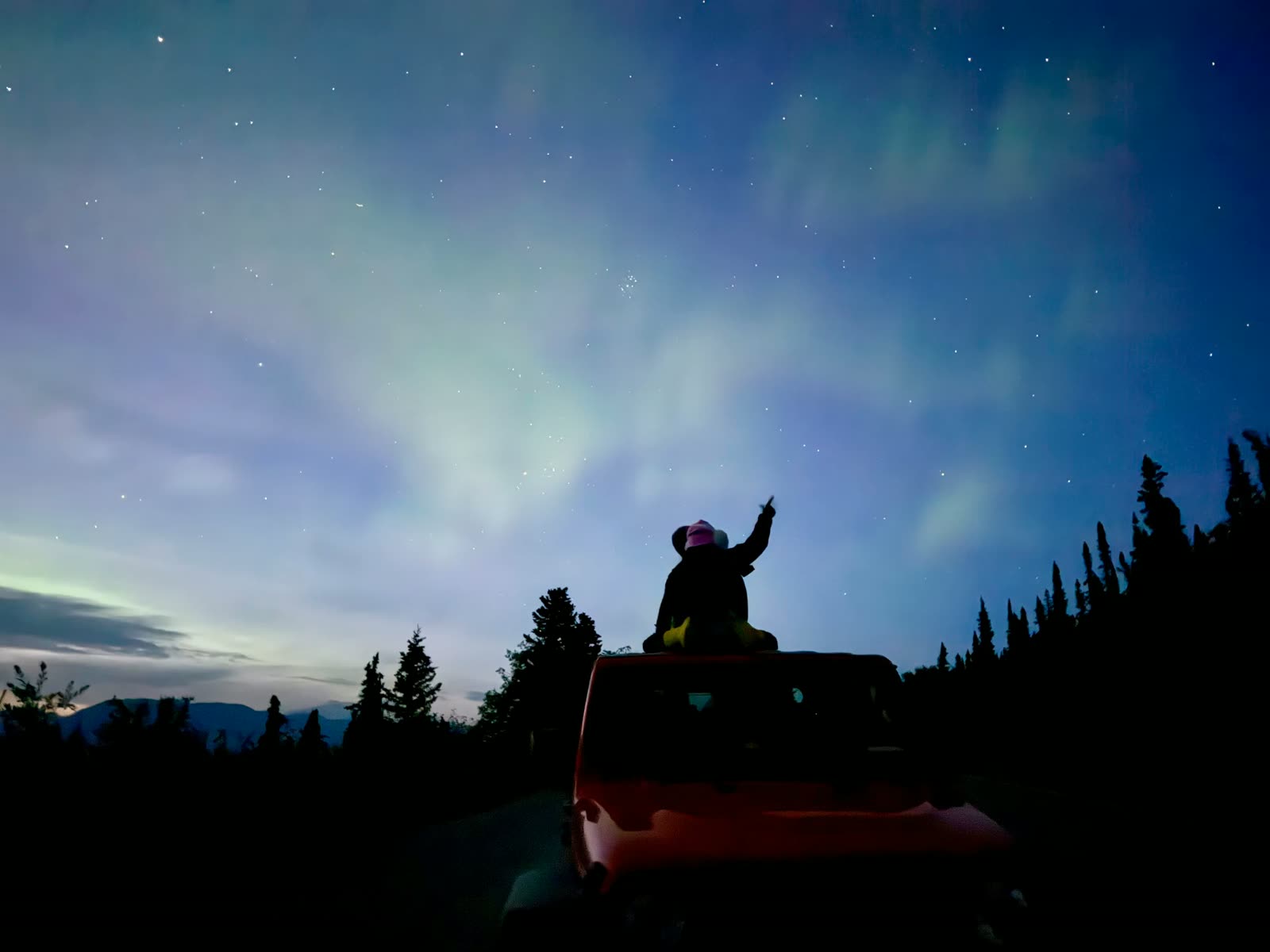
↑ Unit 6 · Three Eyes, One CosmosOur Own Observation Nights
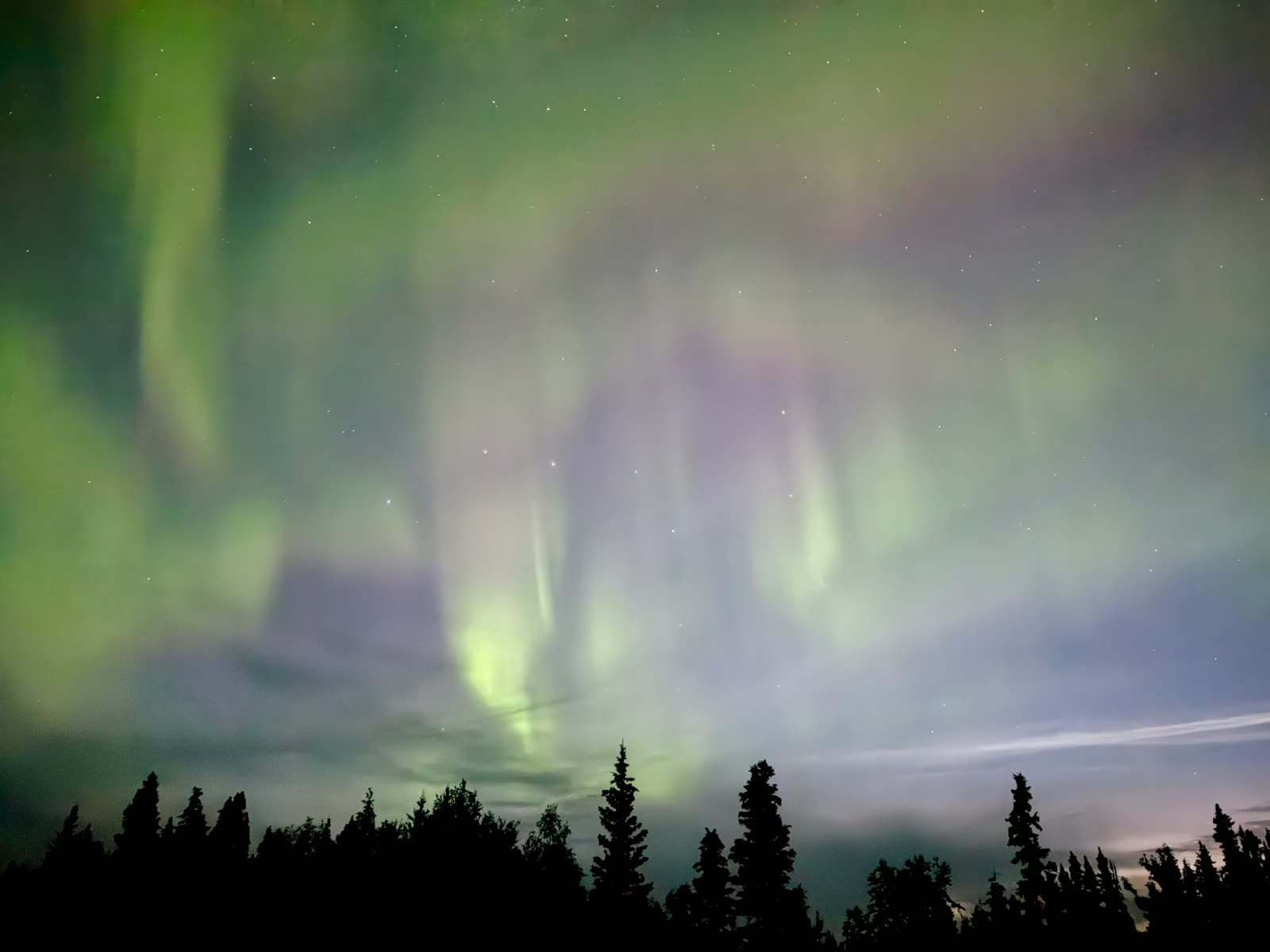
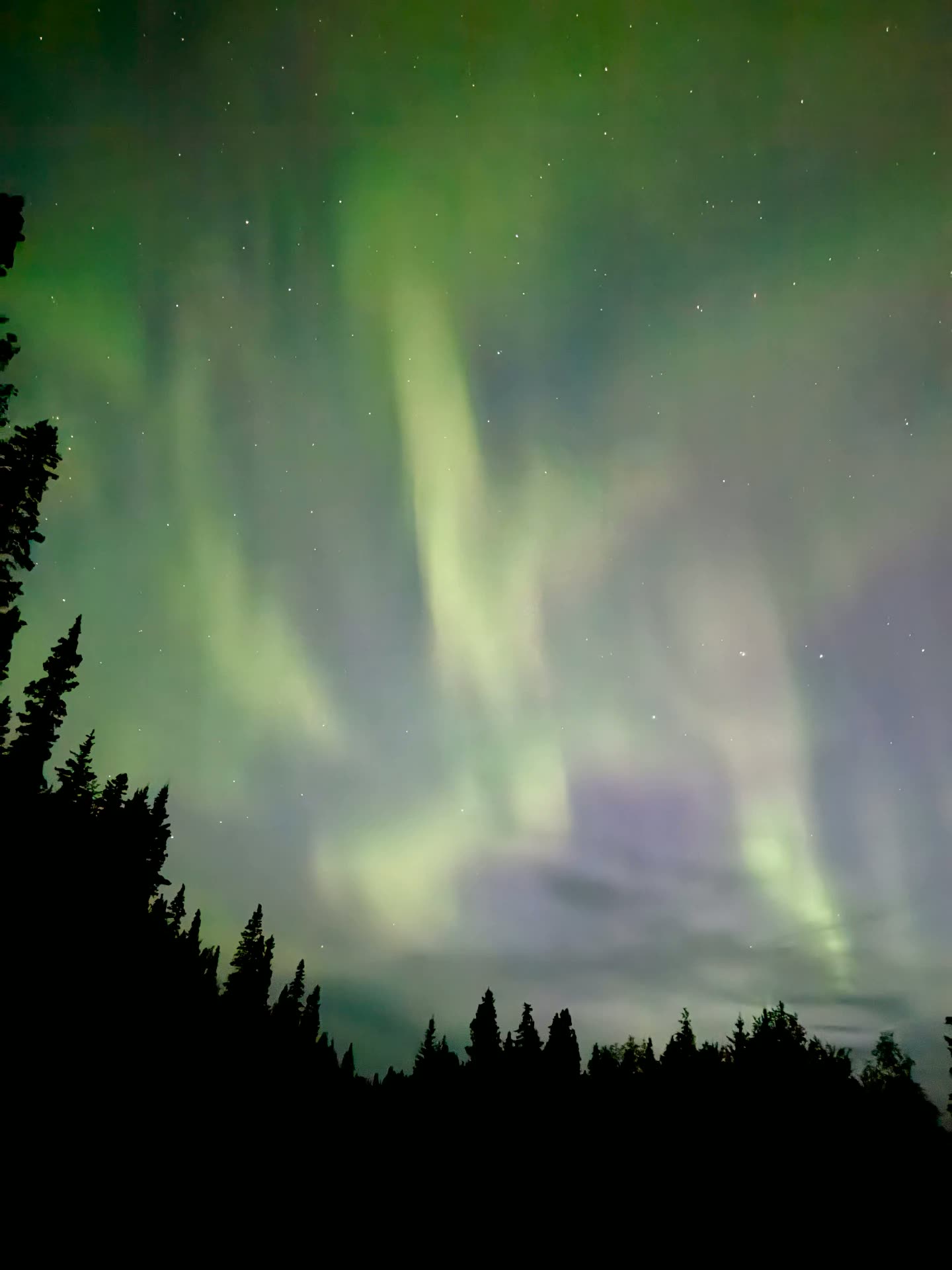
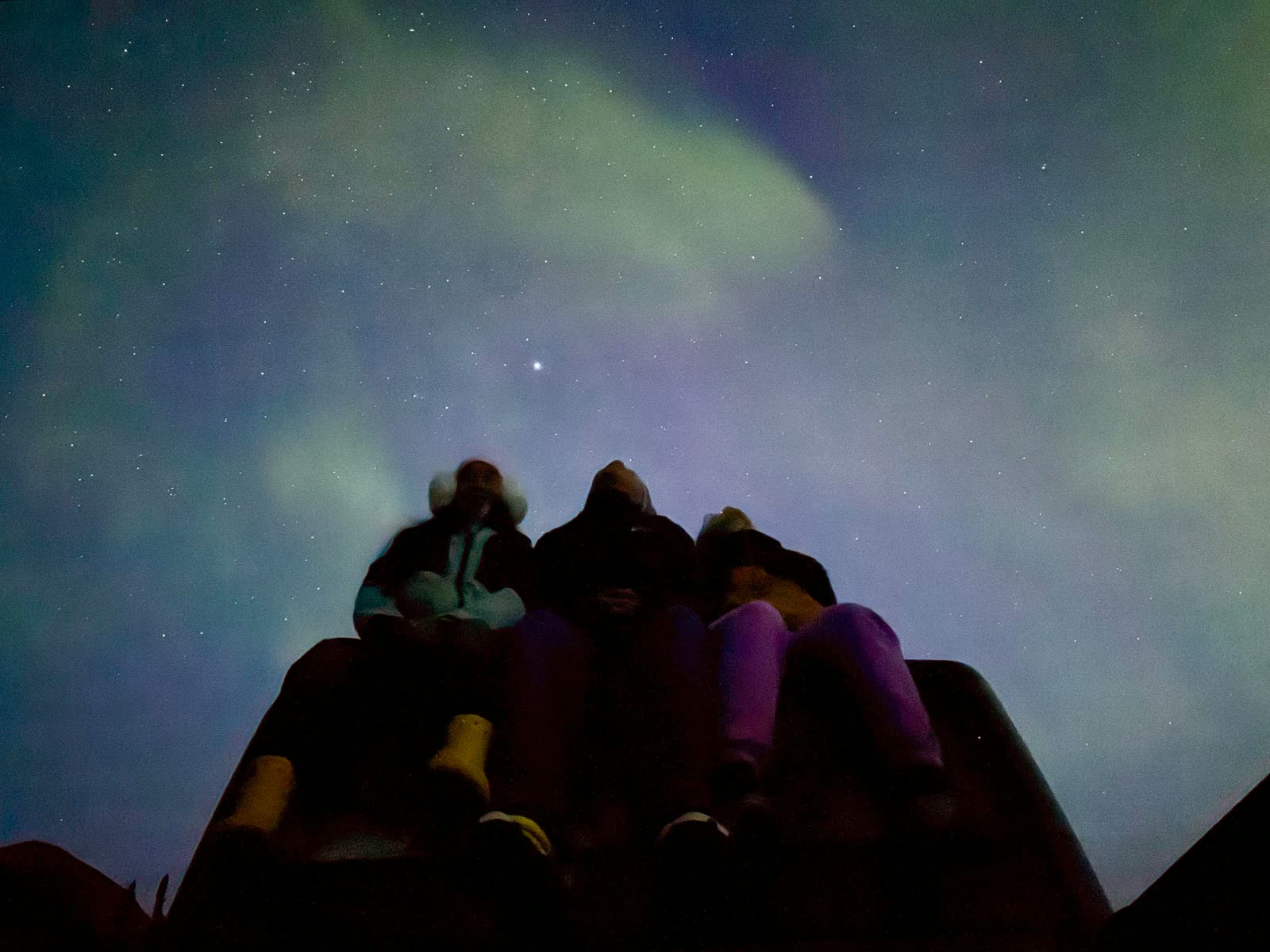
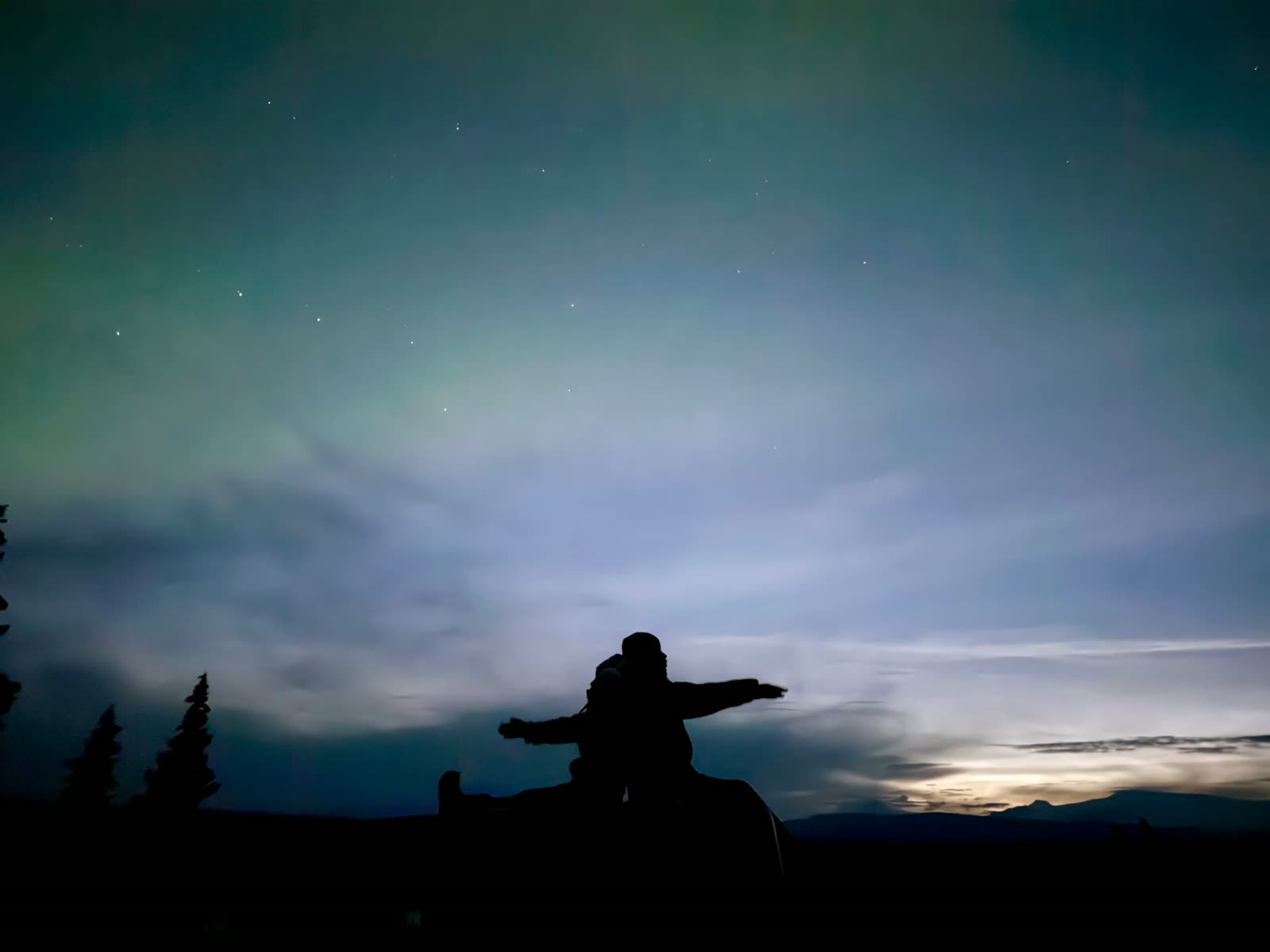
Kiuguyat over our own spruce line — the proof that this course is not theoretical.
Sample Lesson · The Sky and the Earth
One week, two grades, the same question asked at two depths.
For Lucy 悟
| Day | Activity | Description | Connection |
|---|---|---|---|
| Monday | Introduction | "What do you see in the sky? What do you see on the ground?" | Meet the principle. |
| Tuesday | Observation | Outdoors: what patterns are in the sky? On the ground? | Practice 候 (hòu) — waiting and noticing. |
| Wednesday | Story | Read and talk about 牛郎织女, the Cowherd and the Weaver Girl. | Second Eye. |
| Thursday | Art | Draw: what is written in the sky, and written again on the ground? | Express the principle. |
| Friday | Reflection | Share the drawing; write one sentence in the journal. | Synthesis. |
For Lucas 空
| Day | Activity | Description | Connection |
|---|---|---|---|
| Monday | Introduction | Read and unpack 在天成象,在地成形 — what does it claim? | Second Eye: Chinese cosmology. |
| Tuesday | Research | How does Sila express the same principle in Iñupiaq cosmology? | First Eye: Iñupiaq cosmology. |
| Wednesday | Observation | Document sky and earth patterns — photographs, sketches, timestamps. | All three eyes. |
| Thursday | Writing | Essay: how are the patterns of the sky reflected in the patterns of the earth? | All three eyes. |
| Friday | Presentation | Present observations and writing to the family. | Synthesis. |
Discussion Questions
Ask these outside, after dark, with your head tipped back.
First Eye · Iñupiaq
- · What is Sila, and how does it connect the sky and the earth?
- · What is Qilak, and how does the sky guide life on the land?
- · How do Iñupiat read the sky to know when to hunt, harvest, and travel?
- · How does the aurora connect the spiritual world to the physical one?
Second Eye · Chinese
- · What does 天人合一 mean, and how does 在天成象,在地成形 express it?
- · How do the 24 Solar Terms carry the sky down into the fields?
- · How does 牛郎织女 show a sky pattern becoming a human story?
- · What does 天人感应 mean — heaven and humanity responding to each other?
Third Eye · Western Science
- · What is the physical connection between the sun and the seasons?
- · How do we observe and measure a pattern in the sky?
- · How do we use data to test whether a sky pattern and an earth pattern really match?
Key Quotes
| Tradition | Words | Meaning |
|---|---|---|
| Chinese | 在天成象,在地成形 | In the heavens, patterns are formed; on earth, shapes take form. |
| Chinese | 天人合一 | Heaven and humanity are one. |
| Chinese | 斗柄东指,天下皆春 | When the Dipper's handle points east, all under heaven is spring. |
| Iñupiaq | Sila | The living breath of the universe — it is alive, and we are part of it. |
| Iñupiaq | Qilak | The sky; the home of souls. |
Resources
Chinese
- · 易經 I Ching — the classical statement of the sky–earth correspondence.
- · 詩經 Classic of Poetry — seasonal and celestial imagery in the oldest Chinese verse.
- · 史記 Records of the Grand Historian — the 天官書 chapter on celestial offices.
Iñupiaq
- · Elders' oral teachings on Sila, Qilak, Nuna, and Imak.
- · "Kiuguyat: The Northern Lights" — cultural and scientific perspectives together.
- · Iñupiaq sea-ice and weather vocabulary as an observational science.
Western
- · NASA solar and aurora observation data.
- · NOAA seasonal and phenology records.
- · Stellarium — the same sky, mapped by many cultures.
Where This Course Lives
This course is a hallway. Every door it opens is already part of our year.
Final Reflection
“Everything is written twice — on the ground and in the sky. The universe is a unified whole; observation is a sacred practice; and the patterns above are also the patterns of our own lives.”